
All Stories

Choosing Between LIME, SHAP, and Permutation Importance: A Practical Guide to Model-Agnostic Explainability
This guide compares LIME, SHAP, and Permutation Importance, three model-agnostic techniques for explaining black-box models. It helps you choose the right method based on whether you need local or global explanations, computational budget, and data characteristics.

Matching Tenant Isolation and Resilience Patterns to Your SaaS Business Tiers
Resilient multi-tenant SaaS architectures are not built from a single pattern but require a tiered approach. The optimal combination of isolation and resilience strategies depends on your pricing strategy and engineering constraints, directly mapping isolation levels to price points.

How Quantum Sensors Work: Superposition, Entanglement, and the Isolation Problem
Quantum sensors achieve unparalleled measurement precision by exploiting quantum phenomena like superposition and entanglement, but their practical deployment faces a critical engineering challenge: balancing the need to isolate delicate quantum states from environmental noise with the necessity of exposing them to the signal being measured. This fundamental tension, along with system complexity and cost, defines the current practical boundaries of the technology.

Why AI Agents Can't Trust Their Own Reflection: Choosing a Self-Correction Architecture
AI agents struggle with self-correction due to a "self-correction blind spot," failing to identify their own reasoning errors. Prioritizing external verification mechanisms over internal reflection is crucial for building robust and reliable self-correcting AI systems.

7 Overlooked AI Visibility Mistakes Costing Your Business: Unsalted Innovations' Proven Fixes
Many businesses are making critical AI visibility mistakes that are costing them customers, as traditional digital marketing tactics are now outdated. Modern success depends on being 'recommendable' to AI assistants, a shift that requires adapting to new strategies and foundational fixes.

EKF, Graph, or Visual SLAM: Which Algorithm Family Fits Your Robot's Environment
This article compares EKF-SLAM, Graph-SLAM, and Visual SLAM, detailing their trade-offs between computational cost and map consistency. It guides robot developers in selecting the most suitable algorithm family based on environment scale, available resources, and desired map accuracy.

CoT, Self-Consistency, or RAG: Choosing the Right Advanced Prompting Technique for Your Enterprise LLM
Selecting the right advanced prompting technique for enterprise LLMs—Chain-of-Thought (CoT), Self-Consistency, or Retrieval-Augmented Generation (RAG)—depends on the specific failure mode you aim to address. CoT enhances reasoning, Self-Consistency boosts reliability, and RAG grounds responses in external data.

Matching SaaS Business Requirements to Multi-Cloud and Hybrid-Cloud Architectural Patterns
Choosing between multi-cloud and hybrid cloud for SaaS involves mapping specific business drivers like data residency, resilience, or latency to documented architectural patterns. This article outlines the decision framework, key patterns, and trade-offs in data consistency and network latency for effective SaaS deployment.

Sparse vs. Dense Attention: How Transformers Trade Cost for Context
Dense attention offers complete context but incurs quadratic computational cost, while sparse attention reduces this by restricting token interactions, enabling longer sequences. The choice between them is a trade-off between efficiency and expressiveness, driven by sequence length and task needs.

A Closer Look at Buy & Charter's AI-Powered Assessment Engine for Smarter Boat Buying
Making a significant investment in a marine vessel requires more than just a keen eye; it demands objective, data-driven insight. Buy & Charter provides exactly that with its AI-powered platform, designed to deliver comp…

Choosing Between On-Device and Split Inference: A Practical Guide to Edge AI Optimization
This guide explores the critical decision between fully on-device and split inference for Edge AI deployment, detailing model optimization techniques and architectural patterns. It provides a framework to help practitioners make informed choices based on latency, hardware constraints, and privacy needs.

SBOMs, Code Signing, and Build Attestation: How to Architect a Verifiable Software Supply Chain
A verifiable software supply chain is built by integrating three key mechanisms: SBOMs to document components, code signing for integrity, and build attestation for process verification. This integrated workflow creates a verifiable chain of custody for software artifacts, crucial for mitigating supply chain threats.

Digital Twins for Industrial Robots: Architecture, Modeling Choices, and the Path to Predictive Maintenance
A digital twin for an industrial robot is a high-fidelity simulation that mirrors the physical machine, enabling predictive maintenance by detecting deviations and simulating fault conditions. The most practical approach combines physics-based modeling for generating synthetic fault data with data-driven machine learning for real-time monitoring, overcoming the challenge of scarce real-world fault data.

Lumen vs. SDFGI: How Two Real-Time Global Illumination Systems Solve Indirect Lighting Differently
Unreal Engine 5's Lumen and Godot 4's SDFGI offer real-time global illumination without lightmaps, but use distinct methods impacting dynamic scene support and performance. Developers must choose based on project needs for dynamism, target hardware, and acceptable overhead.

Questions Startups and Enterprises Ask About ThinkSys Software Testing and QA Services
Choosing a software testing and quality assurance partner is a critical decision for both fast-moving startups and established enterprises. The right QA strategy can accelerate release cycles, reduce production defects, …
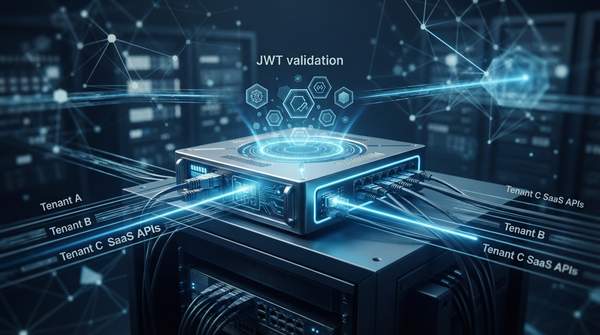
How Header-Based Routing and JWT Validation Secure Multi-Tenant SaaS APIs at the Gateway
Cloud-native API gateways secure multi-tenant SaaS applications by using header-based routing to direct requests to the correct tenant backend and enforcing policies like JWT validation at the edge. This approach provides a single control point for traffic direction and security, reducing the attack surface and improving scalability.

How to Choose the Right Multi-Robot Coordination Strategy
Choosing the right multi-robot coordination strategy (centralized, decentralized, or hybrid) for industrial environments involves balancing performance optimization with system robustness and scalability. The article details the trade-offs of each approach to help make an informed decision based on specific operational needs.

Kawasaki to Launch Compact, High-Speed CP110L Palletizer in North America
Kawasaki Robotics is introducing its new CP110L high-speed palletizer to North America, designed for facilities with space constraints. This compact robot offers a 110 kg payload and high throughput, targeting end-of-line automation needs.

Solving the Quantum Wiring Problem: How Cryo-CMOS Unlocks Scalable Processors
Cryogenic CMOS (cryo-CMOS) circuits are emerging as a critical technology for scaling quantum computers by enabling control electronics to operate at ultra-low temperatures. This integration directly addresses the wiring, power, and complexity bottlenecks that have limited the growth of quantum processors.

Inside Vincere Portfolios: How Its In-House Team Builds and Manages Trading Algorithms
Vincere Portfolios emphasizes its in-house team's role in building and managing its proprietary trading algorithms, distinguishing itself from companies that license third-party technology. This approach, led by Founder Alex Cecola, aims to provide greater control, transparency, and a rigorous approach to automated futures strategies.

Namespace Raises $42M to Target Developer Pain Points With Custom Cloud
Developer infrastructure startup Namespace has secured $42 million in Series B funding to expand its custom compute cloud, designed to address performance bottlenecks and workflow frustrations developers face with generic cloud services. The company's vertically integrated architecture aims to accelerate CI/CD pipelines and provide optimized cross-platform development environments.

Architectural Patterns for Sovereign Enterprise AI
Achieving sovereign AI requires deliberate architectural, operational, and governance choices to ensure AI systems and their data meet stringent jurisdictional and regulatory requirements. Architects must understand distinct patterns like regional isolation, private AI, and federated/edge processing to balance control, complexity, and performance.

Three Mechanisms Driving Quantum Machine Learning's Potential Advantage
Quantum Machine Learning (QML) offers potential advantages over classical AI by harnessing quantum mechanics. Its core mechanisms include mapping data into vast computational spaces, using quantum kernels for pattern recognition, and achieving provable speedups for specific learning tasks.

Choosing Your Multi-Tenant Vector Database Architecture: Silo, Pool, or Hybrid
Choosing the right multi-tenant architecture for your vector database involves balancing data isolation, performance, cost, and operational complexity. Explore the Silo, Pool, and Hybrid models to find the best fit for your generative AI applications.