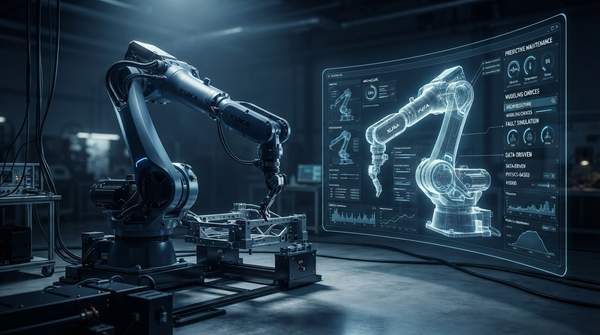
A digital twin for an industrial robot is a high-fidelity simulation of the physical asset, and its most practical near-term payoff is predictive maintenance: using sensor data and machine learning to detect faults and predict failures so that maintenance happens only when needed. The core technical challenge, as Steve Miller of MathWorks frames it, is that real-world fault data is scarce—you cannot let a robot joint fail catastrophically just to collect training examples. The architecture that solves this problem has distinct layers, and the modeling strategy that works best is usually a hybrid one.
Understanding Digital Twins for Industrial Robotics
A digital twin is more than a 3D model of a robot arm. It is a living simulation that stays connected to the physical machine, receiving its sensor data and reflecting its actual condition. In predictive maintenance, the twin serves two roles: it mirrors the robot's healthy behavior so deviations become visible, and it acts as a test bench where faults can be injected safely in software.
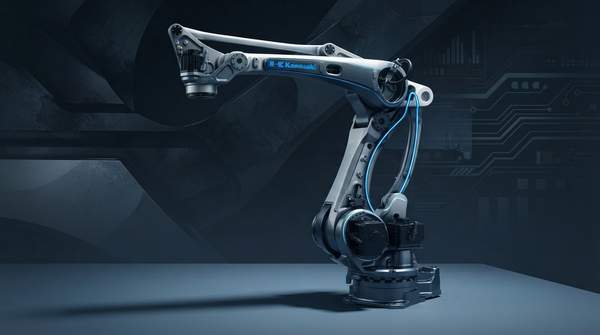
That second role matters because of how industrial robots fail. Permitting faults to occur in the field, Miller notes, may lead to catastrophic failure and destroyed equipment, while generating faults intentionally under controlled circumstances may be time-consuming, costly, or even unfeasible. A digital twin sidesteps both problems by generating sensor data for fault conditions through simulation. For a robot, that means the twin must capture the behavior of joints, actuators, and the control system—not just geometry.