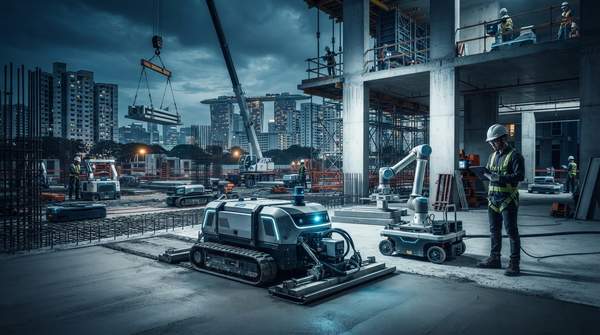
The Housing & Development Board (HDB) is set to significantly expand the use of robotics and automation solutions at Build-To-Order (BTO) construction sites starting in 2027. This strategic move aims to boost construction productivity and reduce manpower needs, according to National Development Minister Chee Hong Tat. The initiative will see the wider deployment of technologies such as floor screeding robots and smart hoists, following successful preliminary trials. Phased Rollout of Robotic Technologies
HDB's adoption of advanced construction technologies is proceeding through a phased rollout. Preliminary trials for screeding robots, which are laser-guided robots designed to level and smooth cement floors, have already been conducted at BTO sites in Bukit Merah and Ghim Moh. These initial trials aimed to assess the robots' performance under various site conditions and their potential for broader implementation, as reported by CNA.
Looking ahead, HDB plans to extend these trials to at least four more BTO projects in 2027. Concurrently, the agency will begin scaling up the use of robotics for floor screeding at more BTO sites from the same year. In addition to screeding robots, smart hoists—automated temporary lifts installed on the exterior of buildings—are slated for deployment at approximately 50% of new BTO sites tendered from 2027. Minister Chee Hong Tat has tasked HDB with working towards deploying these technologies in all new BTO projects.Boosting Productivity and Reducing Manpower Needs
The primary objective behind HDB's push for robotics and automation is to enhance construction productivity and alleviate reliance on manual labor. Minister Chee Hong Tat emphasized that the focus is on technologies that solve practical problems on worksites. For instance, robotics are being applied to labor-intensive processes like floor screeding. While such improvements might seem simple individually, Minister Chee noted that the cumulative manpower savings across numerous blocks and projects will lead to a substantial overall increase in productivity. The deployment of smart hoists, for example, is expected to free up workers for other tasks, further contributing to efficiency.
Cost Implications and Long-Term Expectations
While the initial costs associated with adopting robotics and automation solutions are expected to be slightly higher, HDB anticipates that these costs will decrease over time. This reduction is projected to occur with wider adoption, economies of scale, the maturation of the technologies, and the development of industry capabilities. HDB also clarified that any higher construction costs resulting from these innovations do not directly translate into increased flat prices for home buyers.
The integration of these advanced construction methods is expected to shorten the time required for specific construction activities and improve overall site productivity. However, HDB noted that the overall construction timeline for a BTO project is influenced by various factors, including its design, complexity, and specific site conditions.