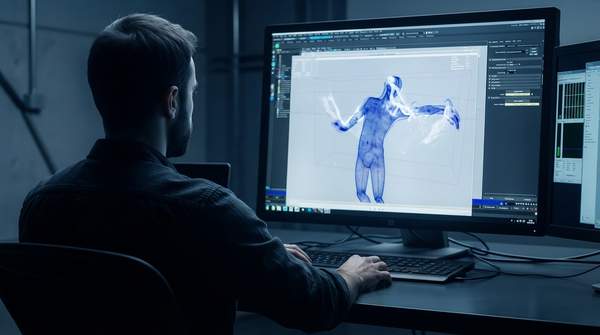
Sony is running a two-track AI strategy for PlayStation, and both tracks now have concrete, named technologies behind them. On the development side, first-party studios are using an internal machine-learning tool called Mockingbird that turns performance capture data into animated 3D facial models in a fraction of a second — work that previously took hours of manual adjustment. On the player side, Sony Interactive Entertainment announced on October 1, 2026 that a new AI upscaling tier called Quick Spectral Super Resolution (QSSR) is coming to the standard PS5, with Marvel's Wolverine and Ghost of Yōtei as the first titles to use it. Underneath both moves sits a consistent corporate message: AI is meant to augment human creators, not replace them.
Sony's Dual AI Strategy: Enhancing Development and Player Experience
The two initiatives serve entirely different audiences, and that distinction is the clearest way to understand Sony's approach. Mockingbird lives inside the production pipeline at PlayStation Studios — it never touches the player directly, but it changes how quickly and cheaply animation work gets done. QSSR is the opposite: it exists purely for the person holding the controller, sharpening and stabilizing the image rendered on a standard PS5 screen in real time.
What connects them is a shared corporate framing that Sony executives laid out in May 2026 and that the company's own engineering blog repeated in October. AI is positioned as a support layer — one that speeds up development on the back end and improves image quality on the front end — while human creative judgment stays at the center of both processes. The October QSSR announcement, authored by Daniel Craig, a principal engineer in graphics R&D at Sony Interactive Entertainment, frames the new library as an answer to a question players and developers had been asking since PSSR launched on PS5 Pro: can these image-quality gains reach the base console?
Mockingbird: Accelerating Game Animation
Mockingbird is a proprietary, internal tool, and Sony has been unusually specific about what it does. The system uses machine learning to convert performance capture data into animated 3D facial models. According to Sony, animation work that once required hours of manual adjustment can now be completed in seconds — or, as the company put it elsewhere, in "a fraction of a second."
The tool is not a theoretical experiment. Reporting on Sony's May 2026 disclosures notes that Naughty Dog, the studio behind The Last of Us, and Santa Monica Studio, the developer of God of War, are among the internal teams already using it. Output from Mockingbird has shipped in Horizon Zero Dawn Remastered, which makes it one of the few concrete examples of generative AI reaching a major console release. Sony has framed the workflow narrowly: the tool handles the mechanical conversion of capture data into facial animation, not the creative decisions around it.