Choosing the Right GI for Your Project Profile
The review's most actionable output is its set of architectural recommendations for three development profiles. Each pairing follows from the criteria in the comparison above, so you can trace the reasoning rather than take the recommendation on faith. A useful way to apply the framework is to locate your project on two axes — the scale of the world you are lighting, and the resources you can spend on lighting it — and see which recommendation that intersection lands in.
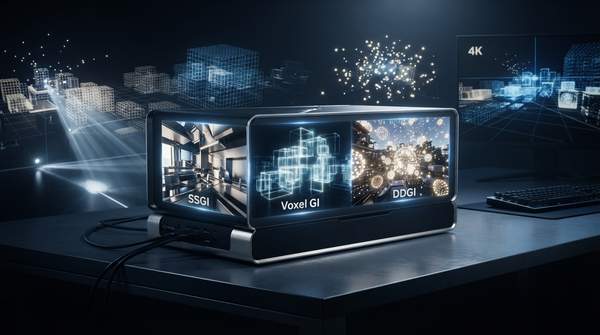
Resource-constrained and small projects: SSGI
For a small team or a project targeting modest hardware, the review recommends screen space global illumination. The logic is straightforward: SSGI's lower hardware requirements align with constrained targets, and its screen-space nature means you are not building or maintaining auxiliary scene representations. You accept the inherent limitation of any screen-space method — indirect light can only come from what the camera sees — but for a small project, that trade is usually acceptable next to the engineering cost of the alternatives.
Consider a hypothetical to make the trade concrete. Suppose a two-person team is building a compact first-person game for a minimum specification that includes integrated graphics. A voxel-based approach would require them to build and maintain a volumetric scene representation on hardware that has little headroom for it, and a probe-based system would demand update and interpolation infrastructure the team cannot staff. Screen space GI gives those developers believable indirect bounce within the frame at a cost their target can absorb. The example is illustrative, not a measured result — but it shows why the review's pairing holds: the constraint, not the ambition, drives the choice.
Linear, medium-sized experiences: Voxel-Based GI
When your game has enough scope that screen-space artifacts become visible, but its structure is contained — a linear experience rather than an open world — the review points to voxel-based global illumination. VGI extends indirect lighting beyond the visible frame by voxelizing the scene, which is exactly what a medium-sized linear game needs: light that behaves believably around corners and off-screen, without the full probe-and-surfel machinery an open world demands. The cost is a more complex implementation and the memory overhead of the voxel representation.
The word "linear" in the recommendation is doing real work. A contained, authored experience gives the voxel representation a bounded problem: the playable space is finite and known, so the volume you maintain and update stays proportionate to the game's scale. The same technique applied to an unbounded world would face a representation that grows with the playable area, which is precisely the regime the review reserves for the next tier of methods.
AA open-world games: DDGI or GIBS
For large-scale open-world titles at the AA tier, the review recommends dynamic diffuse global illumination or surfels-based methods. These techniques are architected for worlds where lighting conditions change across large spaces and must remain stable and dynamic as the player moves through them. The trade-off is the steepest of the three: the highest implementation complexity, the most demanding hardware requirements and a substantial memory footprint. The review positions these methods as the payoff for teams that can absorb those costs — indirect lighting whose quality and dynamism match the scale of the world.
Note that the review offers DDGI and GIBS as alternatives within the same profile rather than prescribing one. Both belong to the same architectural family in its analysis — structured representations that capture and replay indirect light across large spaces — and the choice between them is a finer-grained decision than this framework resolves. If your project lands in this profile, treat the pairing as a shortlist of two, and expect the deciding factors to be the per-criterion details of each method against your engine's existing architecture.
Two boundaries are worth stating plainly. First, this framework addresses diffuse global illumination; ray-traced reflections and refractions are a separate problem with separate costs. Second, the performance discussion reflects relative architectural trade-offs from the review's analysis, not measured benchmark results on specific GPUs — treat the pairings as directional guidance, and validate against your own scenes and target hardware.