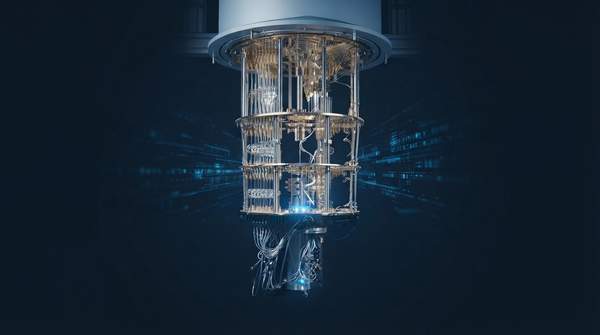
IonQ will install its Superion 256 quantum processing unit at NVIDIA's Accelerated Quantum Research Center (NVAQC), the company announced on September 23, 2026, making it the facility's first on-premise quantum computing deployment. The 256-qubit trapped-ion system will connect directly to an NVIDIA GB200 NVL72 accelerated computing rack through the NVQLink interconnect, with CUDA-Q coordinating hybrid quantum-classical workloads across the unified stack. Physical installation is scheduled for 2027.
IonQ and NVIDIA Forge Hybrid Quantum-Classical Computing Frontier
The NVAQC is a facility built, as IonQ's announcement describes it, to advance the integration of quantum processors with state-of-the-art supercomputing hardware and to help unlock useful quantum applications. IonQ's press release positions the deployment as the center's answer to what it calls the fundamental challenges of scaling quantum processors into a new class of accelerated quantum supercomputers. The significance for researchers lies less in raw quantum hardware than in proximity: placing a QPU on the same premises as NVIDIA's accelerated computing infrastructure removes the distance that has historically separated quantum machines from the classical systems that must feed them data and digest their output.
For IonQ, the selection is also a commercial signal. Quantum Computing Report notes that the installation is scheduled for 2027 alongside the company's first commercial deliveries of Superion 256, tying the research deployment directly to a product IonQ intends to sell. IonQ Chairman and CEO Niccolo de Masi framed the move as the start of something larger: "We see this as the beginning of an exciting era of hybrid quantum-classical computing. This era will be unlocked by multiple generations of Superion systems and NVIDIA's industry-leading AI platforms."
Hybrid Quantum-Classical System Architecture
Deconstructing the announcement into its constituent layers shows how the named components combine into a single research instrument. The table below breaks the partnership into quantum hardware, classical hardware, the interconnect fabric, and the software orchestration layer, then connects those pieces to the system's stated operational function.
| System Layer | Hardware & Fabric | Software Platform | Operational Function |
|---|---|---|---|
| Quantum subsystem | IonQ Superion 256 QPU — 256-qubit, sixth-generation trapped-ion system; first on-premise quantum computer at the NVAQC | — | Executes the quantum portions of hybrid workloads |
| Classical accelerated computing platform | NVIDIA GB200 NVL72 accelerated computing rack | — | Handles the classical processing paired with the QPU |
| Direct interconnect fabric | NVIDIA NVQLink, establishing a direct hardware link between the QPU and the GB200 NVL72 | — | Tightens integration between the two processing domains |
| Software orchestration layer | — | Open-source NVIDIA CUDA-Q platform | Coordinates hybrid quantum-classical workloads across the unified system |
| Research focus | Hybrid software development, large-scale system prototyping, and quantum-GPU co-design | ||
| Application areas | Financial modeling (portfolio optimization, risk modeling), materials science, and computational chemistry for drug discovery | ||
The architecture's defining feature is the NVQLink connection: rather than shuttling quantum jobs to remote hardware, researchers at the NVAQC will have a QPU wired directly into the same computing infrastructure as the GPU platform, with CUDA-Q assigning each part of a workload to the processor best suited to it.