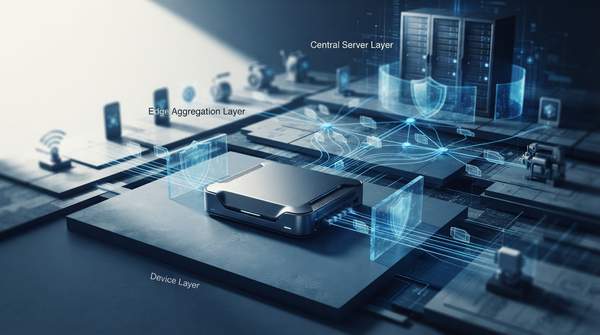
Federated learning lets edge devices train a shared model without their raw data ever leaving the device. Instead of centralizing data, the architecture inverts the pipeline: local devices compute model updates from their own data, transmit only those updates, and a server—or a hierarchy of servers—aggregates them into an improved global model that is distributed back to the devices. The privacy guarantee comes from two reinforcing mechanisms placed at specific points in the pipeline: differential privacy, which adds noise to model updates before transmission, and secure aggregation, which lets the server compute over encrypted updates. This article deconstructs that architecture layer by layer, traces one complete training round, and explains the trade-offs each privacy technique introduces.
Understanding Federated Learning in Edge AI
The core architectural premise is a strict separation between data and model. In a conventional pipeline, devices ship raw data to a data center where training occurs; in federated learning, the training computation moves to where the data already lives. As IBM's technical overview explains, the privacy-preserving architecture of these systems means that sensitive data never leaves a device, which helps minimize the risk of cyberattacks or data breaches. The same property yields a communication benefit: because only model updates travel rather than raw data, the approach decreases latency and reduces the bandwidth required for training.
That bandwidth argument matters most at the edge, where devices are often sensors or smartphones on constrained or unreliable networks. A research framework by Sooraj George Thomas and Praveen Kumar Myakala, published in Scientific Research Publishing, describes federated learning and edge AI as complementary: edge devices perform local computation on decentralized data, while aggregation layers coordinate the result. The two patterns fit together because both push computation toward the data source rather than away from it.
It is important to state the boundary of the privacy claim precisely. Federated learning removes raw data from the transmission path, but the updates themselves are not automatically safe. Google Cloud's explanation of the technique notes that model updates can potentially leak information about local data through advanced techniques like inference attacks or data poisoning. This is why the architecture described below layers explicit privacy mechanisms onto the basic client-server flow rather than relying on decentralization alone.