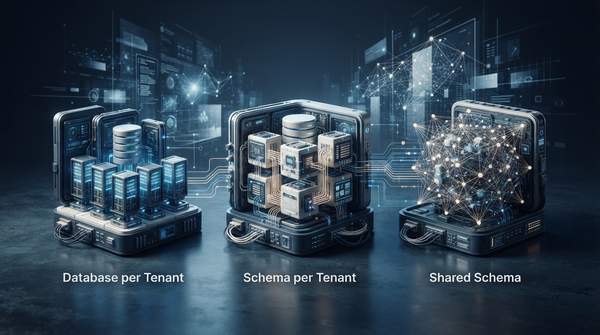
SaaS architects and backend developers face critical decisions when designing cloud-native applications, particularly concerning multi-tenancy database patterns. The chosen pattern significantly influences cost efficiency, operational complexity, security, compliance, and scalability. Three primary models—database-per-tenant, schema-per-tenant, and shared-schema with a tenant identifier—each present distinct trade-offs in how tenant data is organized and managed within a shared infrastructure.
The core challenge lies in balancing data isolation, which ensures one tenant's data and performance are not affected by others, with resource utilization and operational overhead. While the tenancy model does not typically alter an application's core function, it profoundly impacts the overall solution's scalability, per-tenant cost, development complexity, and disaster recovery capabilities. This discussion focuses exclusively on the data layer, excluding application layer multi-tenancy considerations.
Understanding Multi-Tenancy Database Patterns
Multi-tenancy refers to an architectural approach where a single instance of a software application serves multiple tenants, with each tenant's data logically isolated but often sharing underlying infrastructure. The way this data is organized within the database layer defines the tenancy model. Microsoft's Azure SQL Database documentation outlines that multi-tenancy involves a single database storing data from multiple separate tenants, employing mechanisms to protect data privacy. Conversely, single-tenancy dedicates a database to only one tenant.
The selection of a multi-tenancy database pattern is a foundational decision for SaaS applications, impacting everything from cost efficiency and operational complexity to security, compliance, and scalability, as noted by John Adelana, a Senior Startups Solutions Architect at AWS. The three core patterns are Database-per-Tenant (Silo Model), Schema-per-Tenant (Bridge Model), and Shared Database with Tenant Identifier (Pool Model).
Database-per-Tenant: Dedicated Isolation
The database-per-tenant model, also known as the "Silo Model," provides the highest level of data isolation by dedicating a separate database instance to each tenant. This approach ensures complete logical and physical separation of tenant data, which can simplify regulatory compliance and enhance security, according to Supertokens. Each tenant's data resides in its own database, offering predictable performance with minimal "noisy neighbor" issues because resources are not shared directly between tenants.
While offering maximum isolation, this pattern comes with increased resource consumption and operational complexity as the number of tenants grows. Managing a large number of individual databases leads to higher operational overhead for tasks such as monitoring, schema management, and disaster recovery, as highlighted by Microsoft's Azure SQL Database guidance. Consequently, this model typically results in higher per-tenant costs due to the allocation of dedicated database resources for each tenant, making it generally the most expensive in terms of infrastructure. However, it allows for isolated schema changes and supports tenant-specific customizations, offering the highest degree of flexibility per tenant.