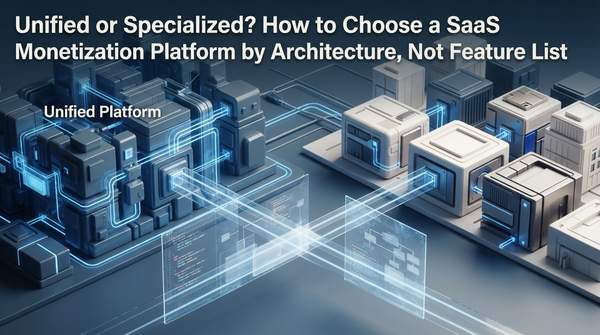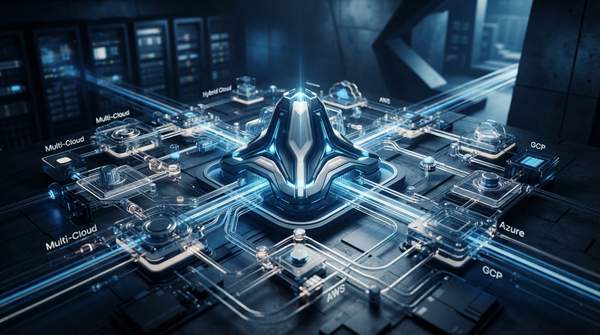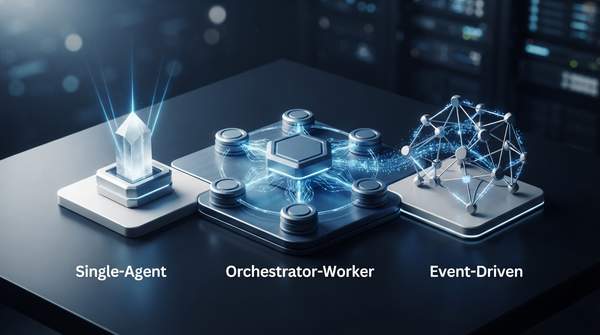
Integrating autonomous AI agents into a Software-as-a-Service (SaaS) platform introduces significant architectural decisions that directly impact scalability, complexity, and performance. Choosing the right pattern is a foundational step for architects and product managers aiming to build robust, maintainable, and effective agentic systems. While a simple, single-agent approach provides a valid starting point, enterprise-grade requirements for complex, high-volume tasks often necessitate more sophisticated multi-agent designs, such as the Orchestrator-Worker model or an Event-Driven architecture. Each pattern presents distinct trade-offs in flexibility and development effort.
According to guidance from Google Cloud, starting with a single agent allows development teams to focus on refining core logic, prompts, and tool definitions before adding more complex components. However, as task complexity or the number of integrated tools increases, a single agent's performance can degrade, leading to higher latency or task failures. In contrast, multi-agent systems offer advantages in specialization and scalability, where individual agents can focus on specific domains, reducing complexity and allowing the system to be modified without a complete redesign. The selection of an architectural pattern is therefore a critical decision that balances immediate development simplicity against long-term operational demands.
The Single-Agent System: A Foundational Starting Point
The single-agent pattern represents the most straightforward approach to integrating agentic AI. In this model, a single, monolithic agent is responsible for understanding a user's request, planning a sequence of actions, executing those actions using a defined set of tools, and synthesizing a final response. This architecture is often the recommended entry point for teams new to agent development, as it contains the complexity within one logical unit, simplifying initial implementation and debugging.
This pattern is best suited for well-defined tasks and product features where the agent's responsibilities are narrow and the required steps are predictable. However, its primary limitation is scalability. As documented by Google Cloud, a single agent's effectiveness can diminish when it is equipped with too many tools or when the tasks it must perform become increasingly complex. This can manifest as increased latency, incorrect tool selection, or a complete failure to accomplish the goal. The monolithic nature of the single-agent system can become a bottleneck, making it difficult to maintain, test, and optimize as new capabilities are added over time.