A missed or delayed diagnosis can change far more than a medical chart. A 2014 study funded by the Agency for Healthcare Research and Quality estimated that diagnostic errors affect about 5% of US adults in outpatient care each year, equivalent at the time to roughly 12 million people.
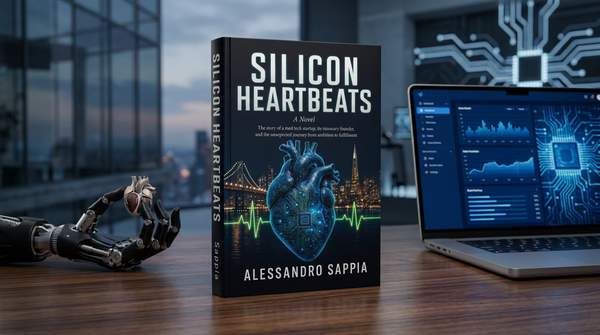
That real patient-safety problem sits behind the opening premise of Silicon Heartbeats. Alessandro Sappia’s literary novel turns diagnostic error into the personal catalyst that drives Alex Mercer toward an ambitious idea for artificial intelligence-powered medical diagnostics.
A Real Patient-Safety Problem Starts the Fiction
The research that informed the novel combined data from three observational studies to estimate the frequency of diagnostic errors in US outpatient care. The researchers arrived at a rate of approximately 5.08%, or about one in every 20 adults.
AHRQ continues to reference the one-in-20 estimate in its diagnostic-safety materials. The agency also identifies diagnostic error as a patient-safety issue shaped by both cognitive and system-level factors, giving the problem a wider context than an isolated mistake by one clinician.
Silicon Heartbeats brings that large-scale problem down to the level of one family. Alex becomes determined to address diagnostic error after witnessing the consequences of a medical mistake and watching his grandmother narrowly survive a misdiagnosis.
The emotional impact gives his later work at Vitanova a reason to exist inside the story. He is pursuing a technological solution because the problem has already become personal long before it becomes a startup opportunity.
Research Gives Alex’s Mission Specific Stakes
Many fictional startups can begin with almost any promising invention. Vitanova Diagnostics is harder to separate from its medical purpose because Alex’s motivation grows directly from the possibility that a diagnosis can be missed, delayed, or wrong.
That purpose shapes the kind of company he chooses to build. Vitanova develops around AI-assisted diagnostics, placing technical ambition inside an area where decisions can carry consequences for patients as well as founders, investors, and employees.
The research background also changes how Alex’s ambition reads. Building the company is tied to a problem he genuinely wants to address, which gives the long hours, fundraising pressure, technical setbacks, and regulatory demands a stronger narrative reason than growth for its own sake.
Sappia can then complicate that mission without making it seem hollow from the beginning. The more Vitanova develops, the more Alex has to reconcile the purpose that started the company with the professional and personal pressures created by trying to make it succeed.
The Novel Keeps Research and Fiction in Their Proper Places
The diagnostic-error statistics establish the scale of a real healthcare concern. Vitanova, Alex, and the events surrounding the company belong to the fictional world of Silicon Heartbeats.
That separation gives Sappia room to use real context without turning the novel into a claim about what one specific technology can accomplish. The book can imagine an AI diagnostic company and the decisions surrounding it while keeping the underlying patient-safety problem anchored in published research.
The result is a stronger premise because the stakes already exist before the fictional solution arrives. Diagnostic error does not have to be exaggerated to make Alex’s motivation plausible, and Vitanova does not need to be presented as a real-world answer for the story to examine the desire to build one.
This balance also suits the novel’s literary focus. Research supplies the pressure point, while fiction can spend time with motive, responsibility, ambition, relationships, and the consequences of trying to turn a serious problem into a company mission.
Medical AI Becomes a Source of Decisions
Once Alex commits to Vitanova, the story moves beyond the question of whether better diagnostic technology would be desirable. He has to build an organization capable of developing, validating, funding, and advancing the idea.
That gives the medical-AI premise practical weight. Technical progress sits beside fundraising, regulation, hospital relationships, leadership choices, and the growing difficulty of separating Alex’s identity from the company he created.
The healthcare setting also makes responsibility harder to treat as an abstract theme. A consumer app can disappoint its users; a technology built around diagnosis enters a category where reliability, evidence, and professional trust carry different consequences.
Silicon Heartbeats uses that pressure to keep its startup story connected to the people affected by the work. The technology matters because Alex believes it can address something consequential, while the novel remains interested in how that belief shapes the choices he makes around the company.
The Research Makes the Premise Accessible Without Making It Simplistic
A background in medicine or machine learning is unnecessary to understand why Alex cares about diagnostic error. The one-in-20 estimate gives the problem an immediate scale, while his grandmother’s experience gives the same issue an intimate one.
That combination lets the novel approach medical AI from two directions. There is a systems-level problem large enough to inspire technological ambition, and there is a personal event powerful enough to explain why one character becomes willing to reorganize his life around it.
The technical material can therefore stay connected to a recognizable human motive. You do not need to understand algorithm architecture to understand why someone who has watched a diagnosis go badly wrong might become obsessed with building something he believes could make the process better.
That accessibility is part of what gives Silicon Heartbeats room to operate as literary fiction. The medical and technological details establish a credible world, then the story can concentrate on what Alex chooses to do inside it.
Real Stakes Create Better Questions for the Story
The most useful effect of the research background is not statistical. It gives the novel a problem serious enough to make Alex’s ambition understandable before Sappia begins testing what that ambition will require from him.
Once the mission has legitimate stakes, questions about funding, ethics, loyalty, trust, and responsibility become harder to dismiss as ordinary startup drama. Alex is not simply protecting a company; he is also protecting an idea that began with a deeply personal belief about what technology might improve.
That creates productive tension as Vitanova grows. The original purpose remains meaningful even when the demands of building the company begin changing Alex’s relationships and priorities.
For a novel interested in both technology and character, that is fertile territory. The research grounds the starting problem, while fiction examines what happens after one person decides that solving it should become his life’s work.
Frequently Asked Questions
Is the diagnostic-error theme in Silicon Heartbeats based on real research?
Yes. Silicon Heartbeats was informed by AHRQ-funded research estimating that diagnostic errors affect about one in 20 US adults in outpatient care each year. The research provides context for the problem that motivates Alex Mercer’s fictional work in medical diagnostics.
What research informed Silicon Heartbeats?
Silicon Heartbeats draws on a 2014 study published in BMJ Quality & Safety that combined data from three observational studies of outpatient diagnostic error. The researchers estimated a rate of about 5%, equivalent at the time to approximately 12 million US adults annually.
Is Vitanova Diagnostics in Silicon Heartbeats a real company?
No. Vitanova Diagnostics in Silicon Heartbeats is fictional, along with Alex Mercer and the other characters in the novel. Real diagnostic-safety research informs the background of the story rather than documenting an actual company or AI system.
Is Silicon Heartbeats a medical book?
No. Silicon Heartbeats is a literary novel set partly in medical technology and artificial intelligence. Its research-informed premise gives the story real-world context while the narrative remains focused on characters, ambition, responsibility, relationships, and the choices surrounding Vitanova.
A Real Problem With a Fictional Answer
The diagnostic-error research behind Silicon Heartbeats gives Alex’s mission a credible reason to begin. From there, the novel can ask what happens when an understandable desire to solve a serious problem becomes a startup, an identity, and a source of increasingly complicated decisions.
Read the book details to see how Silicon Heartbeats turns that research-grounded starting point into a Silicon Valley story about medical AI, ambition, and responsibility.